
| +Home | Museum | Wanted | Specs | Previous | Next |

Singer/Friden EC-1114 Calculator
Updated 7/15/2021
The Singer/Friden EC-1114 is a good example of an early small & medium-scale integration Metal-Oxide Semiconductor (MOS) integrated circuit-based calculator. The machine is a basic 14-digit four-function calculator with memory, typical of desktop office calculators of its time. The machine has IC's with date codes from the mid-1970 timeframe, so it would stand to follow that the exhibited calculator was manufactured sometime in mid to late 1970. After the Singer Company took over the management of Friden, most all of the calculator design and manufacturing was farmed out to the huge Japanese conglomerate Hitachi, Ltd. in Tokyo. The 1114 was entirely designed and manufactured for Singer/Friden by Hitachi. Hitachi marketed this calculator in their home market as the Hitachi ELCA-24.

The Singer/Friden EC-1114 Minus Top Cover
The 1114 is built from five circuit boards that plug into a backplane with hand-wired interconnects. The boards are oriented horizontally inside the calculator, supported by a stamped sheet-metal cage. Rubber isolation blocks provide some shock mounting for the boards. The circuit boards are constructed of phenolic material, and have circuit traces on both sides of the board, with plated-through via holes providing connectivity between the component and reverse side of the circuit board. A metal edging crimped around the perimeter of the circuit boards acts as a structural enhancer to minimize flexing of the circuit boards.

Internals with Keyboard Assembly Removed
The top circuit board in the stack is smaller than the other boards, and contains most of the power supply conditioning and regulation circuitry, along with keyboard encoding logic. The second board provides the display subsystem, including the 14 Hitachi-made CD-79 Nixie tubes and their associated driver circuitry, which is made of mostly discrete components. The remaining boards comprise the calculating logic of the machine, and are populated with numerous small- and medium-scale integration devices, with a lot of diodes, resistors, and a few transistors sprinkled amongst the chips.

The Circuit Boards of the EC-1114
All of the 59 integrated circuits that make up the logic of the 1114 are Hitachi-made HD31xx-series PMOS devices. The HD31xx-series devices consist of small and medium-scale circuits, containing at least a few gates or flip-flops, or at the higher integration level, a multi-bit shift-register or binary coded decimal serial adder. The HD31xx-series devices were purposefully developed by Hitachi for calculator applications. The date code used on these Hitachi parts are different than used on US-made integrated circuits. The code consists of a single digit, which is the last digit of the year of manufacture, followed by a single letter (A-Z), which appears to indicate a two-week period in the year (A=week 1/2, B=week 3/4 ... Z=week 51/52) in which the part was made. This is in contrast to the now more standard date codes which are indicated by YYWW, with YY being the last two digits of the year, and WW being the week in the year in which the part was manufactured.

Keyboard Detail
The EC-1114 is a very conventional machine for its day. It operates in (per the operators manual) "floating decimal input, and fixed decimal output". This means that on input, the decimal point can be positioned anywhere, but displayed results will always have the decimal point at a fixed position, which is determined by a rotary switch on the keyboard panel. The decimal point can be set at any position from zero to nine digits behind the decimal point. The memory operates conventionally, with [M+] and [M-] keys for adding or subtracting the display to/from the memory register, memory recall ([S]), and memory recall/clear keys ([T]). A push-on/push-off [∑] key allows for the sum of products or quotients to automatically accumulate in the memory register. The machine provides a push-on/push-off [K] key that enables the constant function when depressed. The constant mode works for multiplication and division operations only. The [R] key swaps the content of the hidden operand register and the display register. The [CE] key clears the display of erroneous entries, and the [C] key clears the entire machine except for the memory register. A small slide switch sets the rounding mode of the machine.

Hand-Wired Backplane
Indicators on the left end of the display indicate error and overflow (labeled "UDF", which, according to the manual, stands for UnDerFlow) and another, labeled "M", which indicates when the memory register contains a non-zero value. A similar annunciator on the right end of the display indicates a negative number appears in the display.
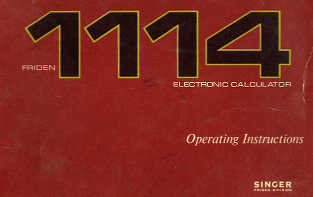
Cover of the EC-1114 Operator's Manual
The EC-1114 is measurably faster than its predecessor, the
Friden EC-1113. This was
due to the 1113 using Hitachi's first-generation HD700-family of PMOS
integrated circuits, which had slower operational speeds than Hitachi's
second-generation
HD3100-family PMOS ICs
used in the 1114. Addition and subtraction complete virtually instantly.
Multiplication and division involve slightly more
time to complete, but no calculation, even the "all 9's divided
by 1" benchmark takes something around 200 milliseconds (1/5 second)
to perform. The displays are left active during calculation, and in more
complex multiplication and division problems, the digits dance through the
display in a hasty blur before the result is displayed.